Page 1 of 1
Antarctican Conscript
Posted: Tue Apr 09, 2013 1:32 am
by Linguist Wannabe
This is my first ever conscript, so please bear with me. I'd really like to know everyone's thoughts and opinions on this, both positive and negative.
It is designed to write the Antarctican conlang (
http://linguifex.com/index.php?title=Antarctican), and is typically carved into stone. As such, it only contains straight lines. It was heavily influenced by Japanese katakana, and there are many correspondences between symbols in the two scripts, although sometimes they represent different sounds (e.g. テ indicates /te/ in katakana but /ne/ in Antarctican, although it can be modified by a diacritic to indicate /te/).
It is a syllabary, but one that only indicates four vowels /a/, /i/, /e/ and /u/. Other vowels are indicated by diacritics and or digraphs. Likewise, the only consonants it indicates are voiced sonorants and the glottal stop, with diacritics and digraphs used to indicate other consonants.
First I'll do the nasals. There are 15 base symbols for syllables beginning with plain nasals, however in the modern language two of them have the same meaning /ɲi/. From these, another 15 symbols are derived that indicate prestopped nasals, by putting a diacritic immediately before the syllable.
Please let me know what you think. I am also curious to know if it would be possible to make a font for this conscript. It's not a topic I know much about.
Thanks

Re: Antarctican Conscript
Posted: Tue Apr 09, 2013 2:54 am
by Linguist Wannabe
Another diacritic is used to derive voiceless stops and affricates from nasals at the corresponding point of articulation. This is a vertical line below the symbol.
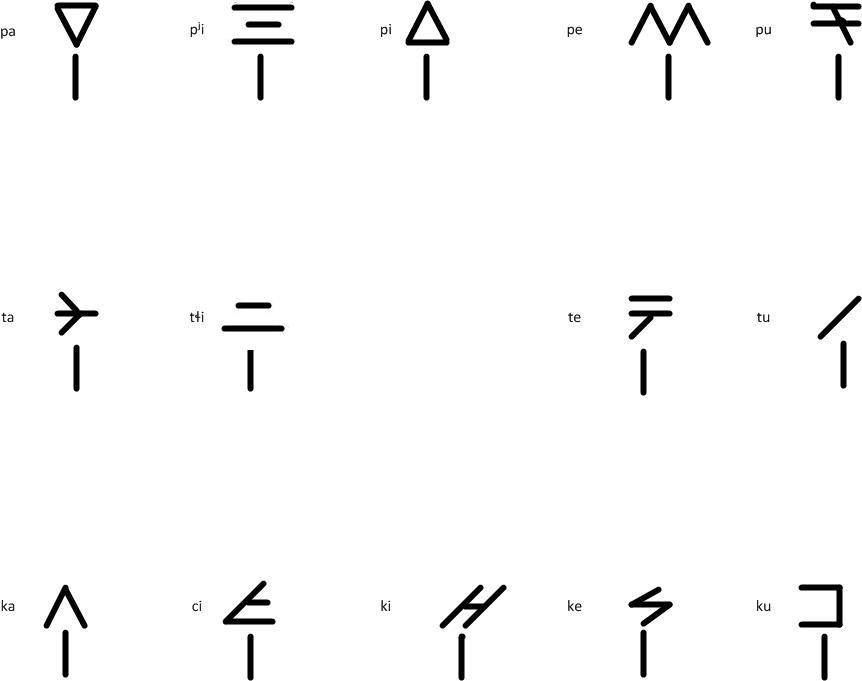
- Voiceless Stops.JPG (23.34 KiB) Viewed 7132 times
Here are the rest of the base symbols (that indicate syllables beginning with the glottal stop and with approximants).
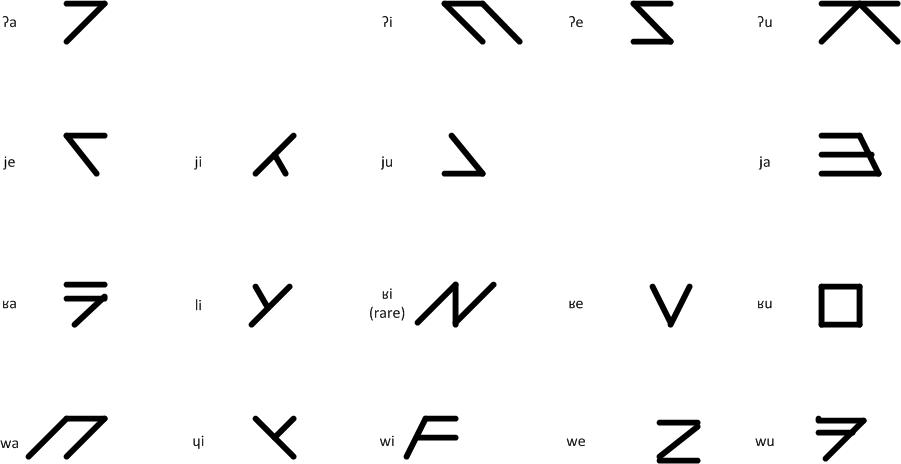
- Vowels_and_Semivowels.JPG (21.85 KiB) Viewed 7132 times
Voiceless fricatives are formed from these by placing a vertical line above and below the symbol for the corresponding approximant e.g. to go from /w/ into /f/, from /j/ into /ç/ or from /ʁ/ into /χ/. Doing the same to syllables beginning with the glottal stop produces syllables beginning with /s/.
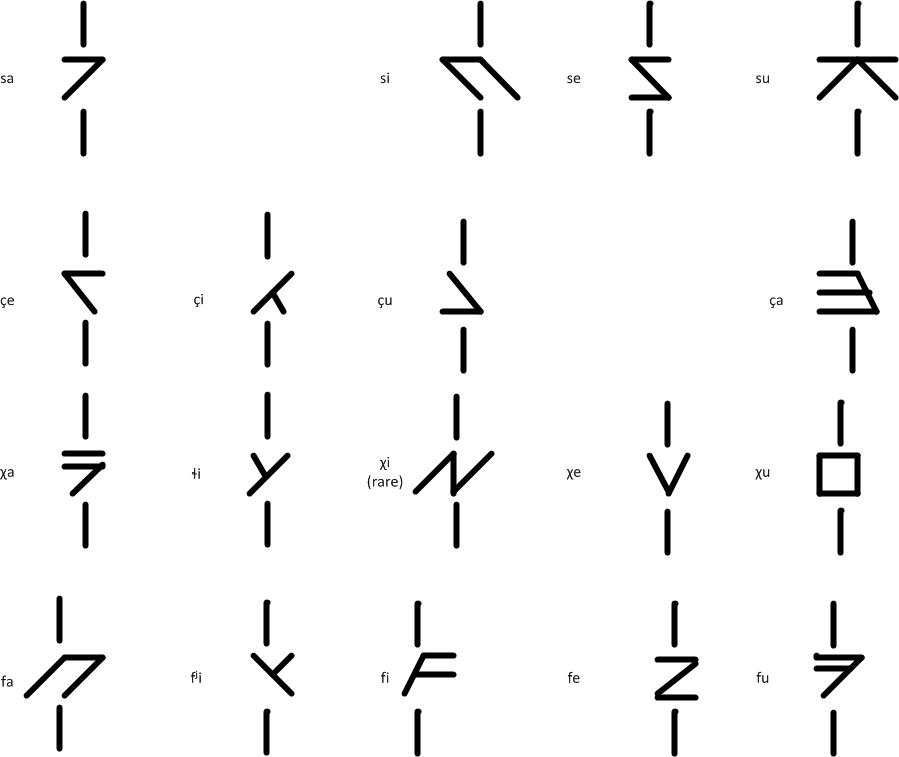
- Voiceless Fricatives.JPG (33.78 KiB) Viewed 7132 times
Re: Antarctican Conscript
Posted: Tue Apr 09, 2013 2:56 am
by Linguist Wannabe
The symbols for voiced obstruents (stops, affricates and fricatives) are derived from their voiceless counterparts by deleting any diacritics and then adding a vertical line above the symbol.
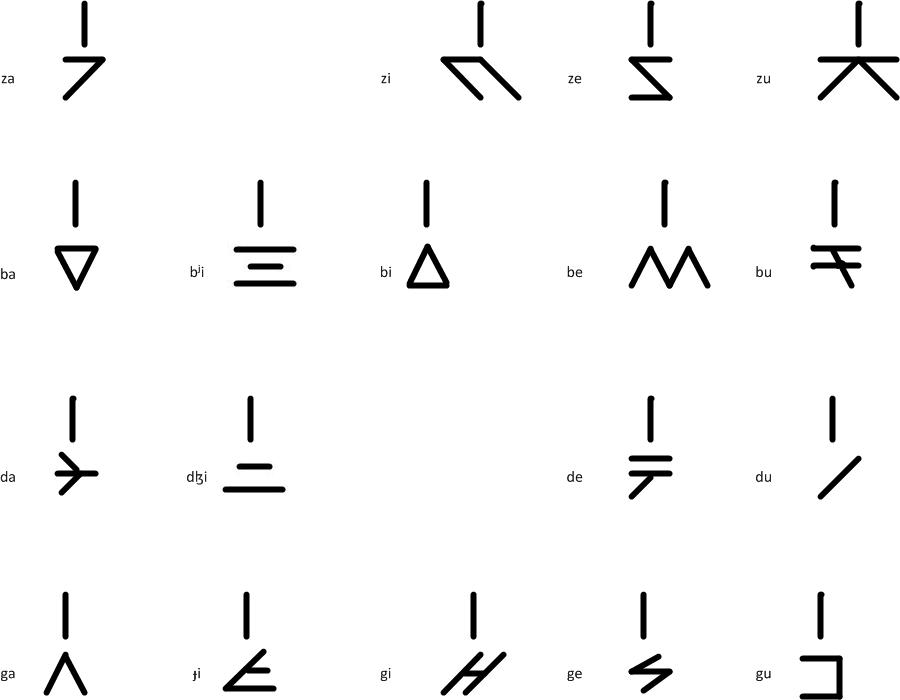
- Voiced Obstruents.JPG (29.3 KiB) Viewed 7131 times
The gaps in the charts indicate syllables forbidden by Antarctican phonotactics.
Re: Antarctican Conscript
Posted: Tue Apr 09, 2013 3:14 am
by clawgrip
It looks interesting but pretty basic, which is not especially unusual if carving into rocks is the main way of writing. Future versions of the script could be interesting.
I am currently working on a font of someone else's script at the moment, but I could eventually make one for you.
Re: Antarctican Conscript
Posted: Tue Apr 09, 2013 8:13 am
by Linguist Wannabe
clawgrip wrote:It looks interesting but pretty basic, which is not especially unusual if carving into rocks is the main way of writing. Future versions of the script could be interesting.
I am currently working on a font of someone else's script at the moment, but I could eventually make one for you.
Thanks a lot for offering to help. What I've posted at the moment is only the very beginning though. Antarctican phonology is pretty complex, so there's a lot more that I still need to do to make sure the script can handle everything.
Re: Antarctican Conscript
Posted: Tue Apr 09, 2013 9:25 am
by Linguist Wannabe
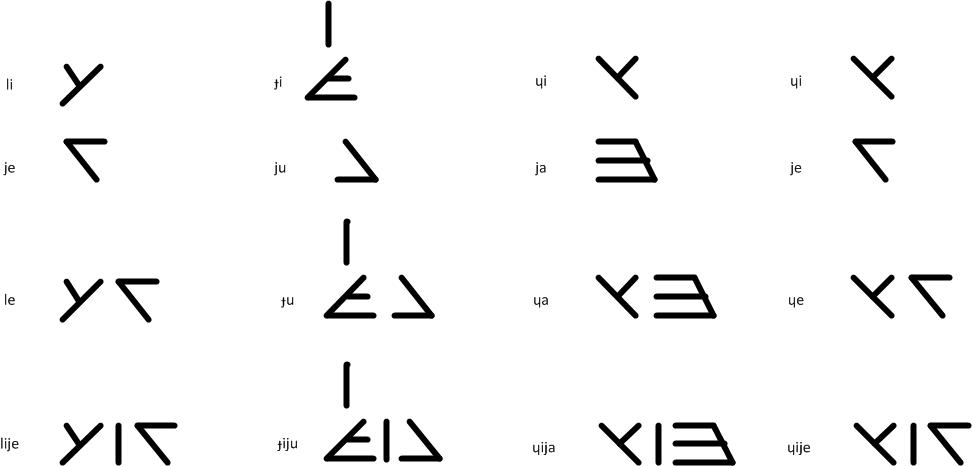
Now I'll get started on digraphs. You might have noticed that some consonants only have symbols for syllables where they are followed by /i/. Specifically, these are the base symbols for /mʲ/, /ɲ/, /l/ and /ɥ/, as well as all of the consonants derived from these by adding diacritics i.e. /pmʲ/, /pʲ/, /bʲ/, /tɬ/, /dɮ/, /cɲ/, /c/, /ɟ/, /ɬ/ and /fʲ/. These are the
Antarctican "soft" consonants, all of which were originally palatalised in the proto-language (
http://linguifex.com/index.php?title=Proto-Antarctican).
However, Antarctican permits these consonants to be followed by any vowel. The orthography handles this by using digraphs. These consist of the symbol for Consonant + /i/, followed by the symbol for /j/ + Vowel. To indicate pronunciation as two separate syllables, a vertical line is inserted between the symbols e.g.
- Soft Consonant Digraphs.JPG (26.5 KiB) Viewed 7098 times
Re: Antarctican Conscript
Posted: Tue Apr 09, 2013 9:32 am
by Dewrad
As it happens, the impression I get from this script is "futuristic", not "epigraphic", although it certainly looks like it could develop a fascinating handwritten script. Is the influence solely from Japanese katakana, or have south-east Asian scripts had any input? A cross between katakana and Thai script would be awesome.
Any samples of the script in use?
Re: Antarctican Conscript
Posted: Wed Apr 10, 2013 5:51 am
by Linguist Wannabe
Dewrad wrote:As it happens, the impression I get from this script is "futuristic", not "epigraphic",
It is actually meant to be used in the future, albeit at a time when society had regressed to a similar technological level as the dark ages.
Dewrad wrote: although it certainly looks like it could develop a fascinating handwritten script.
I am actually thinking of making a related handwritten script that people use when they are writing on a medium that allows curved lines.
Dewrad wrote:Is the influence solely from Japanese katakana, or have south-east Asian scripts had any input? A cross between katakana and Thai script would be awesome.
I thought about doing this, but decided against it because of how SE Asian scripts are full of curved lines, which do not lend themselves to being carved into stone.
Dewrad wrote:Any samples of the script in use?
Coming soon. But first I need to finish describing all of the pronunciation rules. Apart from anything else, I haven't covered how the script deals with vowel length, diphthongs, nasal codas, tone, and ejectives.
Re: Antarctican Conscript
Posted: Wed Apr 10, 2013 7:09 am
by clawgrip
Linguist Wannabe wrote:I thought about doing this, but decided against it because of how SE Asian scripts are full of curved lines, which do not lend themselves to being carved into stone.
There seems to be a common belief that writing carved in stone needs to be only straight lines, but this is not necessarily the case. SE Asian scripts themselves were often carved in stone.

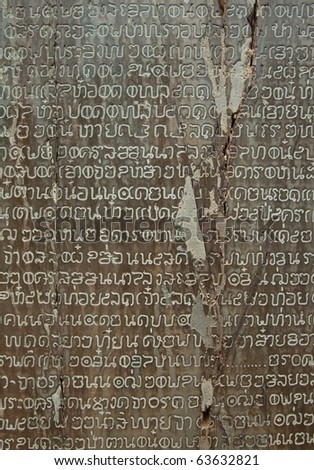


Carving in wood, on the other hand, may more likely require straight lines because of the grains.
Re: Antarctican Conscript
Posted: Wed Apr 10, 2013 9:14 am
by Drydic
FORTUNATELY WOOD DOES NOT EXIST ON ANTARCTICA
Re: Antarctican Conscript
Posted: Wed Apr 10, 2013 9:19 am
by Dewrad
clawgrip wrote:Linguist Wannabe wrote:I thought about doing this, but decided against it because of how SE Asian scripts are full of curved lines, which do not lend themselves to being carved into stone.
There seems to be a common belief that writing carved in stone needs to be only straight lines, but this is not necessarily the case. SE Asian scripts themselves were often carved in stone.
Also compare, I dunno, the Roman alphabet:

Re: Antarctican Conscript
Posted: Wed Apr 10, 2013 10:35 am
by Nortaneous
Carving in wax, on the other hand, *does* lead to straight lines. Roman cursive, for example.
Re: Antarctican Conscript
Posted: Wed Apr 10, 2013 8:16 pm
by GBR
I wonder if the point is not whether the script developed on stone. If that's the case, you might keep the lines straight to save on time? Chisels tend to be straight after all.
On a related note, I've been experimenting with clay recently, and although you can get curves, straights a lot easier.
Re: Antarctican Conscript
Posted: Wed Apr 10, 2013 8:57 pm
by Linguist Wannabe
clawgrip wrote:Linguist Wannabe wrote:I thought about doing this, but decided against it because of how SE Asian scripts are full of curved lines, which do not lend themselves to being carved into stone.
There seems to be a common belief that writing carved in stone needs to be only straight lines, but this is not necessarily the case. SE Asian scripts themselves were often carved in stone.
Good point about that. I should have known because I've been to Angkor Wat after all.
clawgrip wrote:Carving in wood, on the other hand, may more likely require straight lines because of the grains.
I just did some reading on the Runic script, which was frequently carved into wood. While it did indeed lack curved lines because of this, it also lacked horizontal lines because of the grain of the wood. Not quite sure how this works, but looking over the alphabet I did indeed see that it lacked horizontal lines.
Drydic Guy wrote:FORTUNATELY WOOD DOES NOT EXIST ON ANTARCTICA
Presently it does not, but at the time when this script is used, runaway global warming has melted the icecaps, and the continent has been ice-free long enough for taiga forest to develop across much of the continent.
Nortaneous wrote:Carving in wax, on the other hand, *does* lead to straight lines. Roman cursive, for example.
This is a very good point. Thanks a lot for such an excellent idea. I hadn't thought about the possibility of using wax tablets at all. But I'm definitely going to have the Antarctican concultures use wax tablets a lot in their writing. They would be a lot lighter than lugging pieces of stone around. Plus they are reusable.
GBR wrote:I wonder if the point is not whether the script developed on stone. If that's the case, you might keep the lines straight to save on time? Chisels tend to be straight after all.
I was thinking that it would have developed on stone. The early Antarcticans would have been surrounded by lots of it for a few centuries until soils started to form. Though I'm thinking they might have used wax as well (when they wanted to send messages as opposed to just having their writing in one place.
GBR wrote:On a related note, I've been experimenting with clay recently, and although you can get curves, straights a lot easier.
Or maybe clay tablets as well as wax tablets. I notice that the cuneiform script developed on clay and is full of straight lines.
Re: Antarctican Conscript
Posted: Wed Apr 10, 2013 9:19 pm
by GBR
Linguist Wannabe wrote:
GBR wrote:On a related note, I've been experimenting with clay recently, and although you can get curves, straights a lot easier.
Or maybe clay tablets as well as wax tablets. I notice that the cuneiform script developed on clay and is full of straight lines.
That probably also had a lot to do with the stylus they were using as well. The characters that developed into cuneiform we're very curvy - but then I don't know what they were written on/with.
Re: Antarctican Conscript
Posted: Wed Apr 10, 2013 10:05 pm
by Nortaneous
Linguist Wannabe wrote:clawgrip wrote:Carving in wood, on the other hand, may more likely require straight lines because of the grains.
I just did some reading on the Runic script, which was frequently carved into wood. While it did indeed lack curved lines because of this, it also lacked horizontal lines because of the grain of the wood. Not quite sure how this works, but looking over the alphabet I did indeed see that it lacked horizontal lines.
Could the wood be rotated to prohibit vertical lines instead? If so, you could make the script be written on wood and only have to redesign three characters and the diacritic.
Re: Antarctican Conscript
Posted: Wed Apr 10, 2013 10:24 pm
by Linguist Wannabe
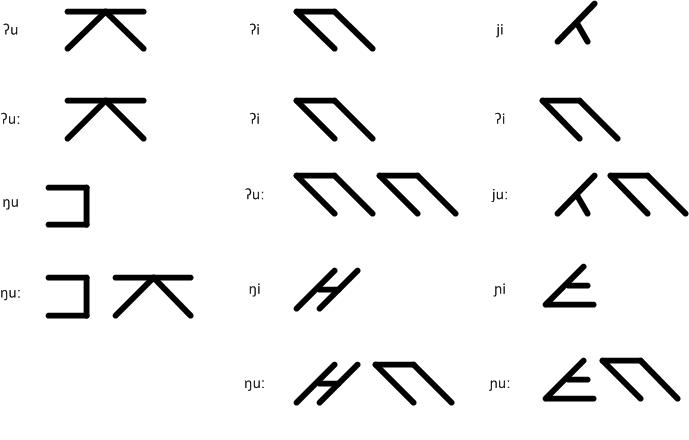
The next thing I'll talk about is vowel length. The simplest case is for syllables containing /i/. These are lengthened by adding the symbol for /ji/. A vertical line is used to if the two symbols are to be read as two separate syllables and not a digraph.
There are two ways to generate a long /uː/. The first is straightforward, to simply add the symbol for /ʔu/ after a symbol for a syllable ending in /u/. However, it can only be used for syllables beginning with a hard consonant.
The second is to use a symbol for a syllable ending in /i/ instead. This can begin with either a hard or a soft consonant. This is then followed by the symbol for /ʔi/ (not the syllable for /ji/, which would generate a long /iː/)
- Long High Vowels.JPG (23.12 KiB) Viewed 6946 times
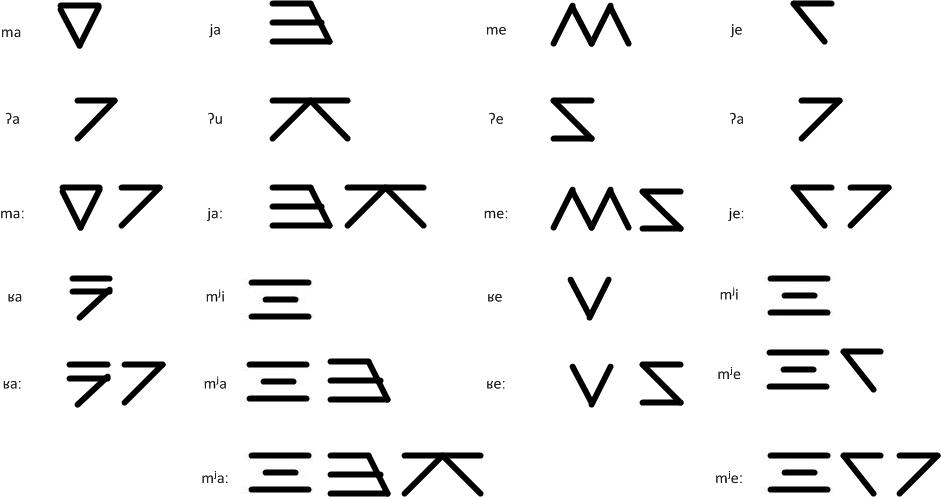
Syllables containing /a/ are lengthened by adding the symbol for /ʔa/ if the initial consonant is hard, and /ʔu/ if the initial consonant is soft.
Syllables containing /e/ are lengthened by adding the symbol for /ʔe/ if the initial consonant is hard, and /ʔa/ if the initial consonant is soft.
- Long Low Vowels.JPG (35.16 KiB) Viewed 6964 times
Re: Antarctican Conscript
Posted: Wed Apr 10, 2013 10:39 pm
by Linguist Wannabe
Nortaneous wrote:Linguist Wannabe wrote:clawgrip wrote:Carving in wood, on the other hand, may more likely require straight lines because of the grains.
I just did some reading on the Runic script, which was frequently carved into wood. While it did indeed lack curved lines because of this, it also lacked horizontal lines because of the grain of the wood. Not quite sure how this works, but looking over the alphabet I did indeed see that it lacked horizontal lines.
Could the wood be rotated to prohibit vertical lines instead? If so, you could make the script be written on wood and only have to redesign three characters and the diacritic.
Very good point. I think I will create alternate forms for the three characters (the one for /ʁi/ is rare anyway), the diacritic and the separator, that have diagonal instead of vertical lines, and are used when the script is carved into wood.
Re: Antarctican Conscript
Posted: Sun Apr 28, 2013 5:10 pm
by Qwynegold
I'm not sure about any of this, but boards and sticks and chips of wood tend to be oblong, and these pieces would be held horizontally when runes were carved on to them. If your script doesn't have horizontal lines, then the piece of wood would need to held vertically, and the script would be best written vertically. I think.
