linguoboy wrote:It's been a while since I tangled with this and I have access neither to Pulleyblank's or Baxter's reconstructions at the moment. But here's what I think you get:
*skrel > *skrej
*skrej > *kɛj [phonetically something like *kəɨj according to Pulleyblank]
*kɛj > *kiɛ
*kiɛ > [tɕiɛ] (PY jie)
As for tone, I think it would be first tone (i.e. [55]), but I'm not sure about the effect of the final. (The preinitial probably drops without leaving any trace.) As it so happens, there is an existing Chinese surname pronounced jiē, namely 揭 "raise; announce;uncover". It's a rare one, however (although not a rare character).
FWIW, I "translated" my surname. The first part is an element meaning "bridge", so I use 橋 Qiáo, which is rare enough to provoke comment, but not so rare that people refuse to accept it.
According to Baxter, the initial drops after pre-initial *s- unless the initial is a coronal, so you get: *skre- > *sre- > Middle Chinese ʂe-.
About *-l, Baxter says that "[i]t is also quite possible that Old Chinese also had the codas *-l or *-r or both, but these are difficult to reconstruct from Chinese evidence alone". According to Schuessler's
ABC Etymological Dictionary of Old Chinese, Sino-Tibetan *-l is often found as *-i or *-n in Old Chinese, giving examples like Old Chinese 戲 *haih Written Tibetan 'kʰyal Lushai *kʰaals,
OC 虫 *hməiʔ WT sbrul Lushai *ruul Written Burmese mrwe,
OC 何 *gâiʔ WT bkal;
OC塵 *drən WT rdul,
OC 炭 *thân WT tʰal.
I guess we could try going for both options:
OC *skren > MC ʂen
平
MC ʂen
平 > Standard Mandarin shān ʂan
OC *skrej > MC ʂej
平
MC ʂej
平 > Standard Mandarin shāi ʂaj
...And well... There's the surname 山 Shān... But the Chinese don't use that much as a surname as the Japanese, isn't it?









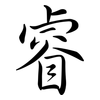


 ) in my Chinese name.