Page 1 of 1
Scandinavian third person
Posted: Tue Apr 06, 2010 8:39 am
by merijn
If I am informed correctly the ending for 3rd person singular on a verb in proto-germanic was -D. How did that become -r in North-Germanic languages? Is it a result of a regular sound change? Or influence from the 2nd person singular? And is the Modern English -s related to it? I know that middle English had -eth but could it be that some dialects had -s under viking influence (and then later North-Germanic had s =>r), and that that ending ultimately "won" in modern times? Or is it a completely independent change?
Before you ask I tried Google but I couldn't find any reliable information.
Posted: Tue Apr 06, 2010 9:34 am
by hwhatting
IIRC Nordic 3rd person -r is the result of levelling and not of a regular sound change.
Posted: Wed Apr 07, 2010 7:05 am
by merijn
Did this leveling take place before or after the s or z changed into r? And if it took place before the change could it be aided by the fact that D and s (or z) are sounds that are pretty close?
Posted: Wed Apr 07, 2010 8:09 am
by hwhatting
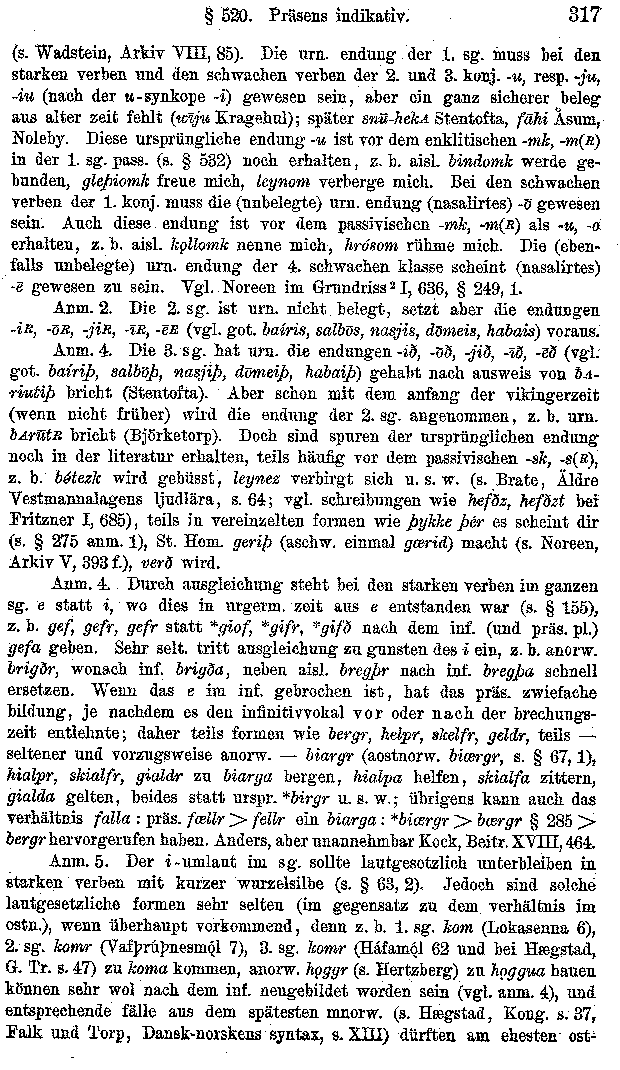
If you read German,
this is what I could find online (Anmerkung 4). I don't know whether there is more information than that online, or something more up-to-date than Noreen's grammar. So it looks like the replacement happened after the development /*z/ -> Norse "R". If the replacement of thorn by /r/ would be a sound change, one would expect that development also in the 2nd pl., but Noreen doesn't mention such forms.
Posted: Wed Apr 14, 2010 8:32 am
by merijn
Thank you! This was the information I was looking for. They do say that this change may have happened earlier if my German is correct (wenn nicht frueher), so it could have happened before the change *z>R.
Anyway my other question remains, why did in English the change -eth>s occur?
Posted: Wed Apr 14, 2010 11:01 am
by hwhatting
merijn wrote:Thank you! This was the information I was looking for. They do say that this change may have happened earlier if my German is correct (wenn nicht frueher), so it could have happened before the change *z>R.
The "wenn nicht früher" refers to the Viking time, meaning that it happened in the 8th or 9th century or before. Whether this means it could have happened before *z>R, I don't know.
Posted: Wed Apr 14, 2010 12:09 pm
by Nortaneous
merijn wrote:Anyway my other question remains, why did in English the change -eth>s occur?
I think both forms were used in different dialects and the -s form eventually took over. Not sure though.
Posted: Wed Apr 14, 2010 10:55 pm
by hwhatting
Nortaneous wrote:merijn wrote:Anyway my other question remains, why did in English the change -eth>s occur?
I think both forms were used in different dialects and the -s form eventually took over. Not sure though.
That is correct, but it doesn't answer the question - the dialects where it started didn't have a general development OE /T/ > /s/, so we still need an explanation why this development happened in those dialects.
Merijn, if I understand you correctly, you want to check whether the English change can be linked to the Norse change?
Posted: Tue Apr 20, 2010 10:23 am
by merijn
hwhatting wrote:
Merijn, if I understand you correctly, you want to check whether the English change can be linked to the Norse change?
Yes.
Posted: Wed Apr 21, 2010 2:38 am
by hwhatting
merijn wrote:hwhatting wrote:
Merijn, if I understand you correctly, you want to check whether the English change can be linked to the Norse change?
Yes.
Tell us if you find out - I at least would be interested to know.
Posted: Mon Apr 26, 2010 10:48 am
by Skomakar'n
So would I.
I, too, have thought of a connection between the varieties, and how *-z could form English -s, German/Dutch -t and Northern -r.
Posted: Mon Apr 26, 2010 11:05 am
by hwhatting
Skomakar'n wrote:So would I.
I, too, have thought of a connection between the varieties, and how *-z could form English -s, German/Dutch -t and Northern -r.
German & Dutch -t have nothing to do with Proto-Germanic *-z / Norse -r. Like older English -th, they go directly back to Proto-Germanic *-T / -D from PIE *-ti.
Posted: Mon Apr 26, 2010 11:54 am
by Skomakar'n
hwhatting wrote:Skomakar'n wrote:So would I.
I, too, have thought of a connection between the varieties, and how *-z could form English -s, German/Dutch -t and Northern -r.
German & Dutch -t have nothing to do with Proto-Germanic *-z / Norse -r. Like older English -th, they go directly back to Proto-Germanic *-T / -D from PIE *-ti.
Yeah. I know that know.
I just wanted to state that I have thought of this too.
I actually didn't know of
-ð in Old Norse third person before reading this, though, but I did know of the variation
es of
er.
Posted: Mon Apr 26, 2010 12:12 pm
by Aszev
Skomakar'n wrote:I actually didn't know of -ð in Old Norse third person before reading this, though
There was no such thing.
Posted: Mon Apr 26, 2010 12:19 pm
by Skomakar'n
Aszev wrote:Skomakar'n wrote:I actually didn't know of -ð in Old Norse third person before reading this, though
There was no such thing.
Maybe my memory fails me.
I am basing this off of something I
think I read last month.
Posted: Tue Apr 27, 2010 10:52 am
by hwhatting
Skomakar'n wrote:Aszev wrote:Skomakar'n wrote:I actually didn't know of -ð in Old Norse third person before reading this, though
There was no such thing.
Maybe my memory fails me.
I am basing this off of something I
think I read last month.
You're not totally off,
Noreen posits
-ð for Proto-Norse. But the only (to me) clear attestations he adduces from Runic and later Norse show -Þ.
Posted: Tue Apr 27, 2010 11:27 am
by Skomakar'n
hwhatting wrote:Skomakar'n wrote:Aszev wrote:Skomakar'n wrote:I actually didn't know of -ð in Old Norse third person before reading this, though
There was no such thing.
Maybe my memory fails me.
I am basing this off of something I
think I read last month.
You're not totally off,
Noreen posits
-ð for Proto-Norse. But the only (to me) clear attestations he adduces from Runic and later Norse show -Þ.
Those are often allophones, though, and generally, the orthography doesn't permit the usage of <þ> in final position, so I'd prefer <ð>, even if they actually had *[θ] there.
That's just me being stubborn, though.