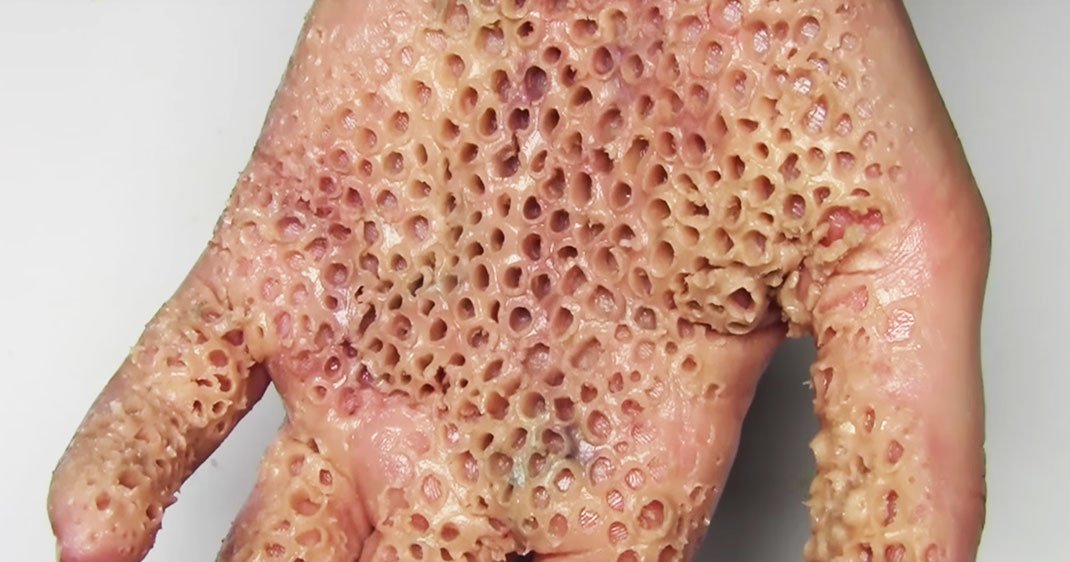
Is "trypophobia" a word?
Posted: Sat Oct 07, 2017 11:36 am
Is "trypophobia" a word? I've seen it used online often for the fear of holes. However no dictionaries recognize it.
Trypophobia is not an official phobia recognized in scientific literature. For many (though perhaps not all) who have it, it's probably not even a real phobia, which the American Psychiatric Association's Diagnostic and Statistical Manual of Mental Disorders says must interfere "significantly with the person's normal routine."
According to Martin Antony, a psychologist at Ryerson University in Toronto, past-president of the Canadian Psychological Association and author of The Anti-Anxiety Workbook, with the exception of a few terms (agoraphobia, claustrophobia and arachnophobia among them), professionals who study and treat phobias tend not to use all the Latin and Greek names that get tossed around on message boards and in the press.
Masai Andrews [...] who runs Trypophobia.com, founded the Facebook group page in 2009 when he was a sociology minor at SUNY-Albany.
There is a Wikipedia page about "Trypophobia" today. It says "The term is believed to have been coined by a participant in an online forum in 2005" although I can't find the word "2005" anywhere in Abbasi's article, which is supposedly the source for the information in that sentence. Maybe the date is actually mentioned somewhere in the Geocities page that Abbasi says existed.Surprisingly, [a Wikipedia page for trypophobia] doesn't exist today. "I can barely keep a page up on the subject without it getting taken down," Andrews says. In March 2009 the powers that be at Wikipedia determined trypophobia to be a "likely hoax and borderline patent nonsense." The deletion page also says that Wikipedia is "not for things made up one day." As for who actually made the word up, that distinction probably belongs to a blogger in Ireland named Louise, Andrews says. According to an archived Geocities page, Louise settled on "trypophobia" (Greek for "boring holes" + "fear") after corresponding with a representative at the Oxford English Dictionary. Louise, Andrews and trypophobia Facebook group members have petitioned the dictionary to include the word. The term will need to be used for years and have multiple petitions and scholarly references before the dictionary accepts it, Andrews says.
Following my letter to the Oxford Word and Language Service on 12th May 2005, I have received a reply from Miss Margot Charlton of Ask Oxford - Oxford English Dictionary. Due to the content of this letter, thank you Miss Charlton for your reply, the name of this phobia is now trypophobia instead of my previously suggested trypaphobia. I quote from Miss Charton's letter below.
"I should perhaps point out that the -a of trypa represents the ending of a Greek feminine noun, and would normally be replaced by -o- in a combination ('trypophobia')."
This was of great interest to me and I am glad that my useage of the Greek was corrected, as my knowledge of Greek is very limited, being almost non-existant. I am now happy that trypophobia is a correctly constructed word.
On the issue of trypophobia being a word accepted into the dictionary, Miss Charlton makes the following comments:
"...there is nothing to prevent anyone inventing and using a new word, but we do not start considering a dictionary entry untikl we have evidence that it has been in sustained and widespread use for quite some time."
In other words, there is nothing preventing us calling our phobia anything we want! And this is why I have taken it upon myself to officially name this phobia:
TRYPOPHOBIA
Louise
23 May 2005
Ireland
They seem to define a phobia based on how it affects the person, not based on what it's a fear of. So essentially, anything can be a real phobia if it affects them badly enough to be on the same level as people who stay indoors at night because they're afraid of being adbucted by aliens if they go out at night.Trypophobia is not an official phobia recognized in scientific literature. For many (though perhaps not all) who have it, it's probably not even a real phobia, which the American Psychiatric Association's Diagnostic and Statistical Manual of Mental Disorders says must interfere "significantly with the person's normal routine."
If she had been aware of that word, she might have passed on it for fear that it would be confused with trypanophobia.zompist wrote:I'm kind of bothered they used Modern Greek τρῦπα instead of Ancient Greek τρῡπημα.
Well, consider the following paragraphs from http://www.mentalhealthy.co.uk/anxiety/ ... bia.html-0Soap wrote: most of us live in places where spiders arent just crawling around in everyone's yards, inside their cars, etc to such an extent that avoiding a spider would be an obstacle to daily life. So I'd say the argument over whether trypophobia is a real fear or not has its place but doesnt mean that people with trpophobia should be considered to be faking it because they read it on the Internet or suffering from delusional psychosis (the belief that one has a mental disorder that does not actually exist). At worst, it means that trypophobia is in the same category as the much better known arachnophobia.
In the event of coming into contact with or seeing a spider, someone with arachnophobia will feel extreme anxiety, they may have to flee the situation.
Symptoms of panic and anxiety, such as rapid heart rate, shaking limbs, nausea, shortness of breath and lightheadedness are common when experiencing a phobic reation. This is the body preparing to 'fight or flee', and can be very distressing for sufferers.
In serious cases, sufferers of arachnophobia may avoid going outside at certain times of the year. Certain behaviours may become the norm – such as ritually searching for spiders on entering a room. Anxiety may be triggered just by the thought of a spider, seeing a picture of one or watching a film that contains spiders.
People often use "arachnophobia" colloquially to refer to something that is not a serious problem, but it seems that fear of spiders can be something disruptive enough to qualify as a phobia under the APA's definition. If "there are no adults in the world with trypophobia severe enough to affect their day to day life in that way", it seems that would be a way in which it is different from arachnophobia, not a way in which they are similar.Rachael has been severely phobic of spiders for as long as she can remember, and is scared of money spiders, tarantulas and every spider in-between. Her phobia does not only affect her in the daytime, it also has a negative effect on her sleeping patterns. She says:
“I regularly suffer from nightmares, where I will have full-on screaming fits. I cannot watch spiders on television and I can't be near them.”
Rachael’s phobia negatively affects her living situation, too, and as she has recently graduated from university, she has found it problematic living with others. In fact, most living situations are affected by her phobia: “It can be a problem when living by myself and when moving in with strangers. The nightmares have also caused issues with relationships as I am such a traumatic sleeper it can affect the sleeping of others”.
https://en.wiktionary.org/wiki/trypophobiaSumelic wrote:Oh, is "trypa" not a valid Ancient Greek noun? It seems to be listed in LSJ, although I don't know what the exact time boundaries are for that dictionary.
It seems odd to me that a longer word based on the root would exist in Ancient Greek, but the shorter word that seems to lack the affix only came to exist later on. Is it expected to need a nominalizing suffix due to being originally a verb root, or something like that? I can't find any clear explanation of the word's etymology; there is a related verb τρυπ(α)ω, but I don't know if that is known to be the origin of the noun, or a derivation from it. Some sources also indicate some kind of connection to the verbs τρυω and τρυχω.
Or is there some difference of meaning along the lines of "τρῡπημα" being more specifically "puncture", while "τρῦπα" is any kind of hole?
From Ancient Greek τρύπα (trúpa, “hole”) + -phobia (from Ancient Greek φόβος (phóbos, “fear, phobia”)), said to have been coined by a blogger from Ireland in 2005.
Yeah, that's a good point. Even as I wrote my post it occurred to me that phobias are generally irrational, and that someone with arachnophobia isn't only going to tense up when they see a spider crawling towards them, but when there might be a spider crawling up and around them. Even if it's in a bathroom that they've cleaned fifty times, or in deep woods in the middle of a snowy winter. I can see how that could be quite disabling.People often use "arachnophobia" colloquially to refer to something that is not a serious problem, but it seems that fear of spiders can be something disruptive enough to qualify as a phobia under the APA's definition. If "there are no adults in the world with trypophobia severe enough to affect their day to day life in that way", it seems that would be a way in which it is different from arachnophobia, not a way in which they are similar.
Of course, it seems plausible that someone could have an APA-phobia of holes also. The APA has a catch-all diagnosis of "Specific Phobia" or "Simple Phobia"; it doesn't define a separate word for every type of phobia.
Germaphobia (which I also have) is in free variation with the alternate spelling germophobia. The spelling with -o- is slightly more dominant on Wikipedia, and on Google theyre about even but I dont believe the numbers Im seeing.I do know of one word where connective "-a-" is used before "-phobia", "agoraphobia", so it doesn't seem like there is anything special about "-phobia" as a second element that requires the use of "-o-" as the connecting vowel
Hmm, I hadn't tried earlier to research the citations the online LSJ gives because of the intimidating abbreviations, but if I'm interpreting them correctly, does it say the word is found in ἐπιμερισμοί by Herodianus (or is that now considered to be by a pseudo-Herodianus?) and texts by Eustathius and Hesychius? It does seem like all of these are after the Classical period of Ancient Greek as defined by Wikipedia, which says it was the 5th and 4th centuries BC. What periodization does Buck use to separate Ancient from other types of Greek?zompist wrote:Buck (A Dictionary of Selected Synonyms in the Principal Indo-European Languages) has τρῡπημα for Ancient Greek and τρῦπα for modern-- also (in his text notes) Byzantine.
It's still possible he's capturing something simple lookups do not, as he was a Greek scholar and should know what he was talking about. Anyone have a dictionary that gives earliest citation dates for Greek...?
Ἐπιμερισμοί “Parsings.” This title is used to refer to two completely different works. Schultz treats them both as no. 41 in his list; the TLG has only the second, as no. 36; and Dyck has only the first, as no. 14.
The first work known as Ἐπιμερισμοί is a collection of fragments concerning etymology; Lentz thought that these were late creations and so could not have a connection with Herodian, but more recently Dyck has argued that the situation is more complicated. According to Dyck, the work is a composite production to such an extent that the question of authorship is meaningless: there may well be a core of material going back to Herodian or at least to his time, but it is no longer possible to separate this material from that derived from other sources. Lentz gives the majority of the fragments in his introduction, and Dyck adds some more; none of the fragments can be found on the TLG. The second work to which this title is applied is an intact piece of considerable dimensions, not by Herodian and probably significantly later than his time, concerning the spellings of vowel sounds that had originally been distinct but had subsequently become identical in Greek (αι/ε, ει/ι, etc.) and containing some discussion of accentuation. This work has been edited by Jean François Boissonade, with a supplement by Arthur Ludwich; Boissonade’s edition but not Ludwich’s supplement is on the TLG.
FWIW, Beekes has this to say s.v. τρυπάω :zompist wrote:Just as a negative update: I can't supply more info. I can't find any specification of where Buck puts Hellenistic Greek. (He qualifies his Greek as "ancient", which probably means Classical.) FWIW I checked Strong's, which collects New Testament Greek, but unfortunately no one referred to holes. (Burrows, yes, but it was a different word.)
Of course, it's also possible that it's an old formation that stayed under the radar of the Classical authors; things like this happen (e.g. there are a few IE words in Middle / Modern Indian languages that are not attested in Vedic). But purely on attestation it doesn't really seem to belong under Classical Greek.Beekes Etymological Dictionary of Greek wrote:A backformation is τρύπη, τρῦπα [f.] 'hole' (Hdn. Epim., AP, H., Eust.). ... Because of the late and rare attestation of τρύπη, the verb can hardly be denominative.