
Welcome!
A well-fleshed-out descendant of Proto-Lukpanic would be great, and a chess-like game sounds cool too. It would fit in both in the Coastal Western sphere or in SE Tuysáfa, I guess. Anyway, I'm looking forward to what you come up with.
Doayâu is spoken about 500 years earlier than Adāta and Fáralo, but I guess you could say this is still roughly contemporaneous in terms of language generations. I'm a bit wary of "playing around with some con-people" though, at least if this means bringing Doayâu into direct contact with the Edastean languages, since I feel this would be rather unlikely. What kind of scenario is it that you're considering here?
Conlang relay [relocated] (aka "The Cursed Relay")
-
TriceraTiger
- Niš

- Posts: 11
- Joined: Mon May 26, 2014 6:41 pm
Re: Akana Conlang Relay 2011 (The Never Ending Relay)
To the latter, it isn't nearly to the extent of bringing two entire communities into contact. What I had in mind was to make an as-of-yet unnamed historical individual who grew up in Poalugbum and spoke the Lukpanic dialect there, moved to the mainland at some point and learned Doayâu, somehow ended up in the Wañelinlawag Empire and learned Šetâmol, and then somehow ended up down the Aiwa. Along the way s/he wrote stuff in languages s/he learned As is clear it's all fairly nebulous at this point; I don't even have this person's occupation settled yet.
Re: Akana Conlang Relay 2011 (The Never Ending Relay)
I see. Yes, I think something like this would be possible. The Wañelinlawag probably have trading connections to the Anheshnalåks - the speakers of Shtåså -, and those definitely have connections to the Rathedān where an early form of Adāta is spoken at the relevant point in time (Shtåså has a few loanwords from Early Adāta). The most difficult thing here would probably be to figure out the situation wrt writing - so far we've mostly assumed that all Western languages except Gezoro, Tjakori, and maybe Shtåså were still unwritten by -500 YP (though it's likely that the latter would adopt writing a few decades after this, i.e. during the height of the Anheshnalåks' power, and possibly even earlier). Actually, maybe one of the plotlines your story could be how writing spread to the Western sphere (particularly to the Wañelinlawag)...TriceraTiger wrote:To the latter, it isn't nearly to the extent of bringing two entire communities into contact. What I had in mind was to make an as-of-yet unnamed historical individual who grew up in Poalugbum and spoke the Lukpanic dialect there, moved to the mainland at some point and learned Doayâu, somehow ended up in the Wañelinlawag Empire and learned Šetâmol, and then somehow ended up down the Aiwa. Along the way s/he wrote stuff in languages s/he learned As is clear it's all fairly nebulous at this point; I don't even have this person's occupation settled yet.
Blog: audmanh.wordpress.com
Conlangs: Ronc Tyu | Buruya Nzaysa | Doayâu | Tmaśareʔ
Conlangs: Ronc Tyu | Buruya Nzaysa | Doayâu | Tmaśareʔ
-
the duke of nuke

- Avisaru

- Posts: 467
- Joined: Thu Apr 06, 2006 1:23 pm
- Location: Leicestershire
- Contact:
Re: Akana Conlang Relay 2011 (The Never Ending Relay)
Good to see there's plenty still going on here 
TriceraTiger: Welcome! Having some more historical characters established and described in Akana is a good thing in my view, and I agree with Cedh that there's an opportunity here for looking at the spread of writing westward. More exploration of the Lukpanic family would be cool too.
And with regard to Akanaran games, I'd be happy to provide a bit of cultural input if you choose Ishe or the Katapaki as the setting.
TriceraTiger: Welcome! Having some more historical characters established and described in Akana is a good thing in my view, and I agree with Cedh that there's an opportunity here for looking at the spread of writing westward. More exploration of the Lukpanic family would be cool too.
And with regard to Akanaran games, I'd be happy to provide a bit of cultural input if you choose Ishe or the Katapaki as the setting.
XinuX wrote:I learned this language, but then I sneezed and now am in prison for high treason. 0/10 would not speak again.

Re: Akana Conlang Relay 2011 (The Never Ending Relay)
I've got a language family in NE Tuysafa, but it's very early--the speakers are Neolithic hunter-gatherers. It's not really fleshed out anyway, though if someone setting up in that area later wants vocabulary for a linguistic substrate I'm game.
I should really do a little more with PNE...
I should really do a little more with PNE...
-
TriceraTiger
- Niš
- Posts: 11
- Joined: Mon May 26, 2014 6:41 pm
Re: Akana Conlang Relay 2011 (The Never Ending Relay)
I think I was under the impression that the Coastal Western tongues, at least, were written in adapted forms of the Lukpanic scripts; the Lukpanab, in turn, got their writing from the Xšali. If so, couldn't Unnamed Historical Figure write languages that don't have written forms by fitting these to write them? In fact, could this be the start of an Akanaran IPA? If not, then wow! I just got here, and already I'm put in charge of plausibly and cohesively getting writing into the Western sphere!
Thanks! I'll probably take you up on the latter in the not-too-distant future!the duke of nuke wrote:Good to see there's plenty still going on here
TriceraTiger: Welcome! Having some more historical characters established and described in Akana is a good thing in my view, and I agree with Cedh that there's an opportunity here for looking at the spread of writing westward. More exploration of the Lukpanic family would be cool too.
And with regard to Akanaran games, I'd be happy to provide a bit of cultural input if you choose Ishe or the Katapaki as the setting.
-
the duke of nuke
- Avisaru
- Posts: 467
- Joined: Thu Apr 06, 2006 1:23 pm
- Location: Leicestershire
- Contact:
Re: Akana Conlang Relay 2011 (The Never Ending Relay)
The issue is there that we don't have much of an idea of how or when Xšali writing propagates westward; it's probably to do with the Anheshnalåks, though. We don't also know what type of script it is. The Ndak Empire use a logographic script, which develops into a range of later scripts including the Fáralo alphabet (which is presumably in use by the Golden Age); meanwhile the Gezoro pick up the idea of writing from either the Ngauro or Ndak or the Xšali, and devise a syllabary before the Ndak conquest.TriceraTiger wrote:I think I was under the impression that the Coastal Western tongues, at least, were written in adapted forms of the Lukpanic scripts; the Lukpanab, in turn, got their writing from the Xšali. If so, couldn't Unnamed Historical Figure write languages that don't have written forms by fitting these to write them? In fact, could this be the start of an Akanaran IPA? If not, then wow!
We're a welcoming bunchTriceraTiger wrote:I just got here, and already I'm put in charge of plausibly and cohesively getting writing into the Western sphere!
People are free to contribute however works best, on the whole, as long as it doesn't degenerate into outright silliness (and other people do pipe up if that happens).That'd be great. I do enjoy conculturesTriceraTiger wrote:Thanks! I'll probably take you up on the latter in the not-too-distant future!
XinuX wrote:I learned this language, but then I sneezed and now am in prison for high treason. 0/10 would not speak again.
Re: Akana Conlang Relay 2011 (The Never Ending Relay)
IIRC the Gezoro used the Tjakori syllabary, which would be derived from an early form of the Xšali script. In theory, writing could have spread to the Western sphere at this time already (c. -2500 to -1800 YP), but it was decided at one point that the Lukpanic cities should be pre-literate, and since they were the most advanced civilization on the western side of the mountains around -1000 YP, it's much more suitable to associate the spread of writing with the empire of the Anheshnalåks in some way.the duke of nuke wrote:The issue is there that we don't have much of an idea of how or when Xšali writing propagates westward; it's probably to do with the Anheshnalåks, though. We don't also know what type of script it is. The Ndak Empire use a logographic script, which develops into a range of later scripts including the Fáralo alphabet (which is presumably in use by the Golden Age); meanwhile the Gezoro pick up the idea of writing from either the Ngauro or Ndak or the Xšali, and devise a syllabary before the Ndak conquest.TriceraTiger wrote:I think I was under the impression that the Coastal Western tongues, at least, were written in adapted forms of the Lukpanic scripts; the Lukpanab, in turn, got their writing from the Xšali. If so, couldn't Unnamed Historical Figure write languages that don't have written forms by fitting these to write them? In fact, could this be the start of an Akanaran IPA? If not, then wow!
Blog: audmanh.wordpress.com
Conlangs: Ronc Tyu | Buruya Nzaysa | Doayâu | Tmaśareʔ
Conlangs: Ronc Tyu | Buruya Nzaysa | Doayâu | Tmaśareʔ
-
TriceraTiger
- Niš
- Posts: 11
- Joined: Mon May 26, 2014 6:41 pm
Re: Akana Conlang Relay 2011 (The Never Ending Relay)
What do we know about the Xšali otherwise, besides the fact that they had a stable state society going fairly early on in Akana history, that their language had clicks, that they had writing in some form, and that they were just generally weird? There's surprisingly little on them and on the Tjakori (on the wiki, anyways). The Gezoro getting their writing from the Tjakori makes a lot of sense, but I'd figure that their adapted script would be somewhere on the continuum of syllabary-abugida, if not an outright alphabetic system. It makes a lot more sense than the Gezoro getting the idea from Ngauro, since the latter lived on way the other side of Peilaš, and I'd think that it stretches credibility to think that they'd get the idea from the Ndak because the two groups shared such a fiercely antagonistic relationship. This all adds up to several scripts already in use in the areas around the Rathedān when the Anheshnalåks took over the region. They could easily have settled for long enough to adapt whatever the Xšali were using at the time, but they could just as easily run with the Tjakori script like everybody else; they could also just as easily adapt it to be anywhere from an abjad to an alphabet. Would the Anheshnalåks spread writing westward by trading with other Western state societies, eventually reaching the Lukpanic coast, or could the Lukpanab also learn about writing from the Xšali from their maritime influence, albeit later on?

Re: Akana Conlang Relay 2011 (The Never Ending Relay)
For what it's worth, there is a sample of the Tjakori syllabary in existence. It is probably contemporaneous with the original reconstruction game, and of debatable canonicity:
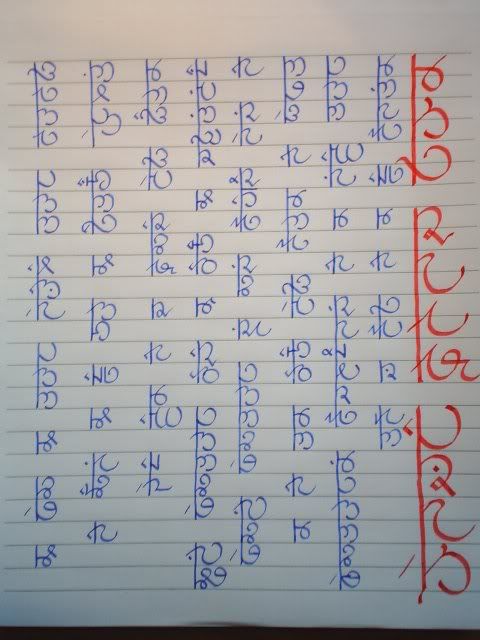
I have no idea what it says, although I suspect it's the Tsinakan text. I recall that it's an abugida, with the inherent vowel /a/ and diacritics marking other vowels: beyond that I haven't the faintest. People are free to make use of this or not as they wish.
I have no idea what it says, although I suspect it's the Tsinakan text. I recall that it's an abugida, with the inherent vowel /a/ and diacritics marking other vowels: beyond that I haven't the faintest. People are free to make use of this or not as they wish.
Salmoneus wrote:(NB Dewrad is behaving like an adult - a petty, sarcastic and uncharitable adult, admittedly, but none the less note the infinitely higher quality of flame)
-
WeepingElf

- Smeric

- Posts: 1630
- Joined: Wed Mar 08, 2006 5:00 pm
- Location: Braunschweig, Germany
- Contact:
Re: Akana Conlang Relay 2011 (The Never Ending Relay)
Beautiful. Like a vertical version of Devanagari, somewhat, but still different - actually more beautiful.
...brought to you by the Weeping Elf
Tha cvastam émi cvastam santham amal phelsa. -- Friedrich Schiller
ESTAR-3SG:P human-OBJ only human-OBJ true-OBJ REL-LOC play-3SG:A
Tha cvastam émi cvastam santham amal phelsa. -- Friedrich Schiller
ESTAR-3SG:P human-OBJ only human-OBJ true-OBJ REL-LOC play-3SG:A
Re: Akana Conlang Relay 2011 (The Never Ending Relay)
Wow, that's a really nice script! It's definitely the Tsinakan text in Adāta; the section up to the first two words of the third column matches the first sentence of the text. (I haven't yet figured out a systematic difference between the diacritics for /e/ and /o/ though, and the characters for /ka/, /za/ and /bi/ look extremely similar too, with the latter apparently missing the expected diacritic in <abise>.)
Blog: audmanh.wordpress.com
Conlangs: Ronc Tyu | Buruya Nzaysa | Doayâu | Tmaśareʔ
Conlangs: Ronc Tyu | Buruya Nzaysa | Doayâu | Tmaśareʔ

Re: Akana Conlang Relay 2011 (The Never Ending Relay)
What are the “hour”, “minute” &c. equivalents in Akana? When do clocks become extensively used?
The conlanger formerly known as “the conlanger formerly known as Pole, the”.
If we don't study the mistakes of the future we're doomed to repeat them for the first time.
If we don't study the mistakes of the future we're doomed to repeat them for the first time.
Re: Akana Conlang Relay 2011 (The Never Ending Relay)
I suspect that there are multiple time-keeping systems; divisions of time shorter than a day are basically arbitrary. The consensus seems to be that the Akanan day is approximately the same length as an Earth day, but different cultures will presumably divide it up differently.Pole, the wrote:What are the “hour”, “minute” &c. equivalents in Akana? When do clocks become extensively used?
Edit: A quick search of the Wiki shows that the word "clock" appears only in the Wihəs lexicon, and that presumably doesn't refer to an early modern-style mechanical clock.

Re: Akana Conlang Relay 2011 (The Never Ending Relay)
That is an elegant script!people wrote:Anheshnalaks, scripts, Xshalad, etc
And speaking of Shtasa, has Radius posted any draft lexicons of Xshali? I've wanted to put a lot of loans into Shtasa but I could only find attested Xshali words in the Adata lexicon.
As I understood early conversations on the subject of Lukpanic writing, any Xshali influence arrived before the migration of the Anheshnalaks to Tjakori. In any event, there's no reason to stop the Anheshnalaks from spreading a more mature version of a Xshali script to their Western kin in Wañelín. There could be equivalent to Earth's Sogdian script, becoming extinct later, if we decide that too many scripts are floating around.TriceraTiger wrote:Would the Anheshnalåks spread writing westward by trading with other Western state societies, eventually reaching the Lukpanic coast, or could the Lukpanab also learn about writing from the Xšali from their maritime influence, albeit later on?
A New Yorker wrote:Isn't it sort of a relief to talk about the English Premier League instead of the sad state of publishing?
Shtåså, Empotle7á, Neire WippwoAbi wrote:At this point it seems pretty apparent that PIE was simply an ancient esperanto gone awry.
Re: Akana Conlang Relay 2011 (The Never Ending Relay)
Well, I have added the word for “clock” in Wihəs quite tentatively and it could refer to any time-measuring device (and also any day-subdivision, by extension, I think).CatDoom wrote:I suspect that there are multiple time-keeping systems; divisions of time shorter than a day are basically arbitrary. The consensus seems to be that the Akanan day is approximately the same length as an Earth day, but different cultures will presumably divide it up differently.Pole, the wrote:What are the “hour”, “minute” &c. equivalents in Akana? When do clocks become extensively used?
Edit: A quick search of the Wiki shows that the word "clock" appears only in the Wihəs lexicon, and that presumably doesn't refer to an early modern-style mechanical clock.
I though it could be cool to have a hexadecimal clock, as an effect of the eightfold division (seen in the eight-day week) applied to both day and night.
If the civilisation in West Tuysáfa at 0 YP were developed enough to support such time-division, that's how the time terms could have looked:
0. yəmu midnight
1. moayəhi yəmowə first [hour] of night
2. eayə yəmowə second [hour] of night
(3. peañ yəmowə third [hour] of night)
(4. nàiyəhi yəmowə fourth [hour] of night)
x. yəhah sunrise (the exact time of that one would depend on the season)
(4. nàhi mìmuha four [hours remaining] to noon)
(5. pai mìmuha three [hours remaining] to noon)
6. e mìmuha two [hours remaining] to noon
7. mohi mìmuha one [hour remaining] to noon
8. mìmu noon
9. moayəhi mìrəwə first [hour] of day
10. eayə mìrəwə second [hour] of day
(11. peañ mìrəwə third [hour] of day)
(12. nàiyəhi mìrəwə fourth [hour] of day)
y. əhəh sunset (the exact time of that one would depend on the season)
y+1. moayəhi yərəwə first [hour] of evening
y+2. eayə yərəwə second [hour] of evening
(y+3. peañ yərəwə third [hour] of evening)
(y+4. nàiyəhi yərəwə fourth [hour] of evening)
As the technology progresses, it could evolve to some more regular system, e.g. this Thai-like one:
0. nàiyəhi yərəwə fourth [hour] of evening / yəmu midnight
1. moayəhi yəmowə first [hour] of night
2. eayə yəmowə second [hour] of night
3. peañ yəmowə third [hour] of night
4. nàiyəhi yəmowə fourth [hour] of night / yəhah sunrise
5. moayəhi yəhan first [hour] of sunrise
6. eayə yəhan second [hour] of sunrise
7. peañ yəhan third [hour] of sunrise
8. nàiyəhi yəhan fourth [hour] of sunrise / mìmu noon
9. moayəhi mìrəwə first [hour] of day
10. eayə mìrəwə second [hour] of day
11. peañ mìrəwə third [hour] of day
12. nàiyəhi mìrəwə fourth [hour] of day / əhəh sunset
13. moayəhi yərəwə first [hour] of evening
14. eayə yərəwə second [hour] of evening
15. peañ yərəwə third [hour] of evening
The conlanger formerly known as “the conlanger formerly known as Pole, the”.
If we don't study the mistakes of the future we're doomed to repeat them for the first time.
If we don't study the mistakes of the future we're doomed to repeat them for the first time.
Re: Akana Conlang Relay 2011 (The Never Ending Relay)
Since the southwestern coast of Tuysáfa is probably at a roughly early bronze age level of technology circa 0 YP, I think it could be appropriate for them to have some type of time-keeping device, most likely a shadow clock of some kind, like a sundial.
For what it's worth, the Tè Jĕnhò divide the day into six unequal segments, which are sort of conceptual rather than corresponding to any precise units of time:
1. ĕnrĕdĕpĭ [əɳədəpʰí], "daybreak, dawn" - the sun rises, people wake up, get dressed, etc.
2. lyàìma [ʎɛ̀ːma], "morning" - first milking, breakfast
3. háí [hɛ́ː], "midday" - general work
4. ĕbĕdră [əbəɖá], "late afternoon, sundown" - cooking and eating, second milking
5. hngòb [ŋ̊òp], "evening" - the sun sets, people socialize, tell stories; typical time for religious observances
6. xég [ɕék], "night" - time for sleeping
It's easy enough to be more specific, but there's rarely much call to get more granular than "early night", "late midday", et cetera.
For what it's worth, the Tè Jĕnhò divide the day into six unequal segments, which are sort of conceptual rather than corresponding to any precise units of time:
1. ĕnrĕdĕpĭ [əɳədəpʰí], "daybreak, dawn" - the sun rises, people wake up, get dressed, etc.
2. lyàìma [ʎɛ̀ːma], "morning" - first milking, breakfast
3. háí [hɛ́ː], "midday" - general work
4. ĕbĕdră [əbəɖá], "late afternoon, sundown" - cooking and eating, second milking
5. hngòb [ŋ̊òp], "evening" - the sun sets, people socialize, tell stories; typical time for religious observances
6. xég [ɕék], "night" - time for sleeping
It's easy enough to be more specific, but there's rarely much call to get more granular than "early night", "late midday", et cetera.
Re: Akana Conlang Relay 2011 (The Never Ending Relay)
Also,

Make the text a conscript reconstruction challenge.
The conlanger formerly known as “the conlanger formerly known as Pole, the”.
If we don't study the mistakes of the future we're doomed to repeat them for the first time.
If we don't study the mistakes of the future we're doomed to repeat them for the first time.
Re: Akana Conlang Relay 2011 (The Never Ending Relay)
The same system is used among the Tyu. The Ronc Tyu terms are:CatDoom wrote:For what it's worth, the Tè Jĕnhò divide the day into six unequal segments, which are sort of conceptual rather than corresponding to any precise units of time:
1. ĕnrĕdĕpĭ [əɳədəpʰí], "daybreak, dawn" - the sun rises, people wake up, get dressed, etc.
2. lyàìma [ʎɛ̀ːma], "morning" - first milking, breakfast
3. háí [hɛ́ː], "midday" - general work
4. ĕbĕdră [əbəɖá], "late afternoon, sundown" - cooking and eating, second milking
5. hngòb [ŋ̊òp], "evening" - the sun sets, people socialize, tell stories; typical time for religious observances
6. xég [ɕék], "night" - time for sleeping
It's easy enough to be more specific, but there's rarely much call to get more granular than "early night", "late midday", et cetera.
1. nrènc [ɳɛ̃̀ʔ] "daybreak, dawn"
2. emàn [ɛˈmɑ̃̀ː] "morning"
3. púo [pʰúə̯] "midday"
4. mà [màː] "late afternoon, sundown"
5. ngónc [ŋɔ̃́ʔ] "evening"
6. śenc [ɕɛ̃ʔ] "night"
Blog: audmanh.wordpress.com
Conlangs: Ronc Tyu | Buruya Nzaysa | Doayâu | Tmaśareʔ
Conlangs: Ronc Tyu | Buruya Nzaysa | Doayâu | Tmaśareʔ
Re: Akana Conlang Relay 2011 (The Never Ending Relay)
That Tjakori script looks a bit reminiscent of sarati.
I actually thought it was the Dāiadak (i.e. Adāta-speakers) who adopted the Tjakori syllabary, rather than the much earlier Gezoro. I’m not sure when the Xšali script is invented, but I imagine it’s no earlier than the first state in the Xšali sphere (the “Old Kingdom”), which the AkanaWiki timeline dates to -2500 YP.
I’m also not sure when writing appears in the Western sphere; at one point it was going to be during the heyday of the Lukpanic cities, but then we decided to make it later for reasons I don't remember. (Anyway, if the timing is right I agree that a transmission route via the Anheshnalåks and perhaps the Wañelin kingdom would make sense.)
Possibly of interest here is something from my notes (a few years old now) that I don't think I ever posted:
Also, I’ve been watching the current relay with interest (and may try to help with the reconstructions if I have time). It’s neat to see Tuysáfa getting filled up with languages! A few thoughts on looking at the various maps on the previous page:
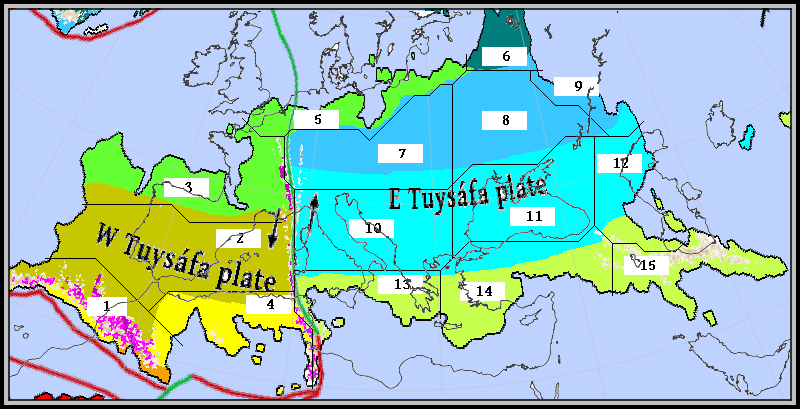
- The coastal regions could support a lot of diversity, especially where they’re also mountainous (cf. western North America, or even prehistoric Europe). Early on, I would expect there to be something like 8-12 unrelated language groups in the southwestern mountains (region 1 on this map) - most of them isolates or very small families - and I imagine some of those could survive the Mbingmik immigration. The regions now occupied by the Leic and Northwest Tuysáfan families (shown on this map) could have been similarly diverse before those groups expanded: I’d suggest 8-10 groups in the Leic area (region 4 on the first map), and possibly more than 20 in the NWT area (region 3 and part of 5) if the Pacific Northwest is any guide.
- The narrow, mountainous peninsula pointing southward at the east end of the Leic region looks to me like the Italy of Akana - not just in size and shape, but also in position - and I think that whoever unites it has a good chance of dominating not only all of southern Tuysáfa but the north coast of Zeluzhia as well. With its mountains and islands it too could have several small language groups before its imperial phase begins (cf. Italy, which had something like 15 languages, only about half of them belonging to Italic), one of which could become the Latin of this continent and erase most of the diversity I’ve been talking about. Maybe this expansion could start just after the time of the relay daughters...
- The distribution of Zju’s Ájnljo family (shown on this map) is striking and a little odd; I think the only plausible explanation for such tiny, widely scattered groups is that they were once very widespread but have since been overrun by later expansions. Perhaps they were the dominant group in the interior of the continent for a long time, until some new development (such as the rise of intensive agriculture, or nomadic herding, or whatever fueled the Leic and NWT expansions?) allowed other groups to replace them.
- Speaking of which, what did cause the relay families to expand? Probably not herding, their locations don’t look right for it. Is it intensive agriculture, or some other technology that gave them a competitive advantage? It seems preferable for it to be something they could both share, to explain why they expand more or less simultaneously.
I actually thought it was the Dāiadak (i.e. Adāta-speakers) who adopted the Tjakori syllabary, rather than the much earlier Gezoro. I’m not sure when the Xšali script is invented, but I imagine it’s no earlier than the first state in the Xšali sphere (the “Old Kingdom”), which the AkanaWiki timeline dates to -2500 YP.
I’m also not sure when writing appears in the Western sphere; at one point it was going to be during the heyday of the Lukpanic cities, but then we decided to make it later for reasons I don't remember. (Anyway, if the timing is right I agree that a transmission route via the Anheshnalåks and perhaps the Wañelin kingdom would make sense.)
Possibly of interest here is something from my notes (a few years old now) that I don't think I ever posted:
Some of this might not work with things that have since been established, and the dates could all be shifted somewhat later anyway (given the huge mountain range separating this region from the eastern civilizations); but maybe it could still be useful as a rough outline/suggestion. I do think it would be good to work out such timelines for all the important regions of Akana (and probably for other kinds of technology too).I wrote:tentative timeline of agriculture + metallurgy in northwestern Peilaš (based on prehistoric Europe)
ca -6000 to -5500: agriculture enters the western sphere (probably from Xšalad)
ca -5500 to -4500: agriculture spreads along the Lukpanic coast, as well as in the northern valleys and plains
ca -4500 to -3500: agriculture reaches the northwestern coastal forests; copper-working enters the western sphere
-3500 to -2500: copper-working spreads all over the west
ca -2250: bronze enters the western sphere
ca -2000 to -1500: bronze spreads along the Lukpanic coast
by -1300: bronze is known all over western sphere; iron is also known, but is very rare and expensive
(ca -1300 to -1100: writing appears in the Lukpanic region?)
ca -500: iron age begins
ca -200: ironworking is known all along the Lukpanic coast
by 0 YP: ironworking spreads all over the west
Also, I’ve been watching the current relay with interest (and may try to help with the reconstructions if I have time). It’s neat to see Tuysáfa getting filled up with languages! A few thoughts on looking at the various maps on the previous page:
- The coastal regions could support a lot of diversity, especially where they’re also mountainous (cf. western North America, or even prehistoric Europe). Early on, I would expect there to be something like 8-12 unrelated language groups in the southwestern mountains (region 1 on this map) - most of them isolates or very small families - and I imagine some of those could survive the Mbingmik immigration. The regions now occupied by the Leic and Northwest Tuysáfan families (shown on this map) could have been similarly diverse before those groups expanded: I’d suggest 8-10 groups in the Leic area (region 4 on the first map), and possibly more than 20 in the NWT area (region 3 and part of 5) if the Pacific Northwest is any guide.

- The narrow, mountainous peninsula pointing southward at the east end of the Leic region looks to me like the Italy of Akana - not just in size and shape, but also in position - and I think that whoever unites it has a good chance of dominating not only all of southern Tuysáfa but the north coast of Zeluzhia as well. With its mountains and islands it too could have several small language groups before its imperial phase begins (cf. Italy, which had something like 15 languages, only about half of them belonging to Italic), one of which could become the Latin of this continent and erase most of the diversity I’ve been talking about. Maybe this expansion could start just after the time of the relay daughters...
- The distribution of Zju’s Ájnljo family (shown on this map) is striking and a little odd; I think the only plausible explanation for such tiny, widely scattered groups is that they were once very widespread but have since been overrun by later expansions. Perhaps they were the dominant group in the interior of the continent for a long time, until some new development (such as the rise of intensive agriculture, or nomadic herding, or whatever fueled the Leic and NWT expansions?) allowed other groups to replace them.

- Speaking of which, what did cause the relay families to expand? Probably not herding, their locations don’t look right for it. Is it intensive agriculture, or some other technology that gave them a competitive advantage? It seems preferable for it to be something they could both share, to explain why they expand more or less simultaneously.
Hüwryaasûr, priestess of the four hegemons, wrote:Ryunshurshuroshan, the floating lizard
Akana Wiki | Akana Forum
Re: Akana Conlang Relay 2011 (The Never Ending Relay)
The conlanger formerly known as “the conlanger formerly known as Pole, the”.
If we don't study the mistakes of the future we're doomed to repeat them for the first time.
If we don't study the mistakes of the future we're doomed to repeat them for the first time.
-
communistplot

- Avisaru
- Posts: 494
- Joined: Thu Oct 07, 2010 6:49 am
- Location: La Ciudad de Nueva York
- Contact:
Re: Akana Conlang Relay 2011 (The Never Ending Relay)
Sorry, I've not really much time to be active anymore tho I still 'lang (and yes I still work on and off on my Akanan stuff). Really the information I, and other members of Team 1 (2011), would need would be grammatical stuff and mayhaps a word list for languages contemporaneous to our proto-language.Zju wrote:It's good to visit other boards, too. This time more timely. Anyway, some guy tried to contact me in january this year about a group of languages spread accross central Tuysáfa, near numbers 2, 10 and 11 (mine creation). When I noticed his question, I replied, but haven't heard him back.
Long story short, I'm willing to give any information about them you want, so long as it doesn't take me too much time to create anything new than what currently exists.
Which reminds me, this'uns for NeonFox, do you have any more information on the Northeastern Tuysafan languages to share? I'd got into contact about helping to flesh out that family a while ago and I'm totally willing, time permitting. Anyway, here and reddit /u/vidurnaktis are the easiest ways to get into contact with me.
The Artist Formerly Known as Caleone
My Conlangs (WIP):
Pasic - Proto-Northeastern Bay - Asséta - Àpzó
My Conlangs (WIP):
Pasic - Proto-Northeastern Bay - Asséta - Àpzó
Re: Akana Conlang Relay 2011 (The Never Ending Relay)
Everything I have is already in the wiki. I keep meaning to make some more notes and put them up, but because of firewall setups and whatnot I can't edit wiki-pages from the computer I spend most of my online time at. I'm actually kind of ashamed of how badly I've fallen down on it.Vidurnaktis wrote:
Which reminds me, this'uns for NeonFox, do you have any more information on the Northeastern Tuysafan languages to share? I'd got into contact about helping to flesh out that family a while ago and I'm totally willing, time permitting. Anyway, here and reddit /u/vidurnaktis are the easiest ways to get into contact with me.

I have a pretty good idea of what the culture looks like, though, if anyone's interested.
Re: Akana Conlang Relay 2011 (The Never Ending Relay)
I, for one, am definitely interested.
-
communistplot
- Avisaru
- Posts: 494
- Joined: Thu Oct 07, 2010 6:49 am
- Location: La Ciudad de Nueva York
- Contact:
Re: Akana Conlang Relay 2011 (The Never Ending Relay)
I def second that, having a good cultural description will help out immensely as well.
The Artist Formerly Known as Caleone
My Conlangs (WIP):
Pasic - Proto-Northeastern Bay - Asséta - Àpzó
My Conlangs (WIP):
Pasic - Proto-Northeastern Bay - Asséta - Àpzó